
1. Why the electricity grid needs reliable models
Electricity transmission and distribution networks operate across extensive and complex territories. Continuity of service, safety and investment planning all depend on having accurate, up-to-date and coherent information.
Working with outdated records, partial datasets or models that do not match what is actually built on the ground increases operational risk, raises costs and makes it harder to justify decisions.
A digital twin of the electricity grid responds to this challenge by providing a structured, verifiable technical model that integrates multiple data sources and documents the criteria behind key decisions in electric power systems.
2. What a grid digital twin offers a technical decision-maker
For a manager responsible for engineering, operations or asset management, the value of a digital twin for the power grid is measured by what it enables in practice.
A mature digital twin provides, among others, these capabilities:
- Accurate reading of infrastructure and terrain
Structures, conductors, slopes, access routes, environmental constraints and right-of-way conditions along the corridor. - Integration of heterogeneous technical data
LiDAR and aerial surveys, terrain models (DTM/DSM), asset inventories, inspection results, design information and other geospatial and tabular sources. - A single technical baseline for all areas that interact with the grid
Operations, maintenance, engineering, planning and analytics work on a shared representation of the network, rather than maintaining separate, inconsistent models. - Verifiable evidence to support decisions
Traceable backing for internal reviews, audits and regulatory processes, based on information that can be checked against reality in the field.
In other words, a digital twin turns an electric power system from a collection of files and reports into a coherent technical reference that underpins both operational and strategic decisions.
3. How a reliable digital twin of the power grid is built
A digital twin is not just a visually attractive 3D model. It is a technical, verifiable and current representation of the grid and its surroundings.
Its usefulness for engineering, operations and maintenance depends as much on how it is built and maintained as on the technology deployed.
In practice, the process combines three key components:
- Continuous validation, updating and traceability.
- Field data capture – including Inspection 4.0 approaches.
- Geometric and topological modelling and integration.
3.1 Data capture: from traditional inspection to Inspection 4.0
The foundation of any reliable digital twin for electricity networks is inspection data. Today, different levels of maturity coexist and can be combined.
Visual and structural inspection
This is the first line of defence. It assesses the physical condition of the network “hardware”:
- Structures and foundations.
- Insulators and strings.
- Conductors and clearances.
- The right-of-way and its immediate surroundings.
At this stage, obvious issues are identified: corrosion, cracking, decay, deformation, vegetation encroachment or third-party elements that may interfere with the line.
Infrared thermography
Thermographic inspections detect “hot spots” that are invisible to the naked eye:
- Loose or corroded connections.
- Phase imbalance and overloading.
- Components operating at the limit and close to failure.
Thermography is an essential tool for preventive maintenance in power systems.
Inspection 4.0: LiDAR, sensors and artificial intelligence
On large transmission and distribution networks, inspection is no longer purely manual. It evolves into Inspection 4.0 schemes in which:
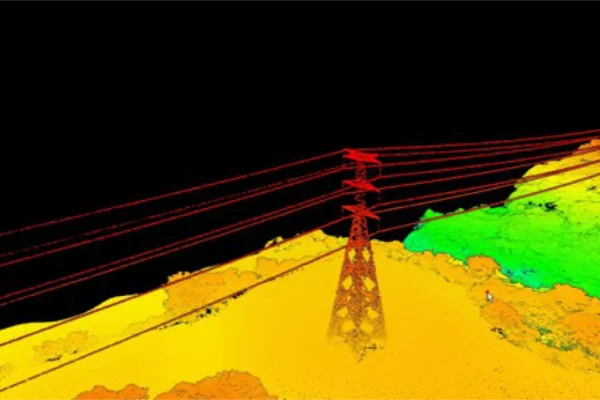
- Crewed aircraft and drones equipped with LiDAR and high-resolution cameras
Scan lines and structures, measuring with high precision the distances between conductors, structures, vegetation and surrounding elements. - IoT sensors and online monitoring systems
Record temperature, vibrations and other variables almost continuously, instead of depending solely on periodic campaigns. - Computer vision and AI algorithms
Analyse thousands of images and point clouds to automatically detect rust, broken insulators, deformed components or risk situations, reducing the burden of manual review.
A robust digital twin for the power grid is fed by this full spectrum of sources, bringing together traditional inspection outputs and advanced LiDAR, sensing and AI capabilities into a single, coherent repository of technical information.
3.2 Geometric and topological modelling
Once the data has been captured, the next step is to transform point clouds, imagery and sensor readings into a geometrically and topologically consistent representation of the grid:
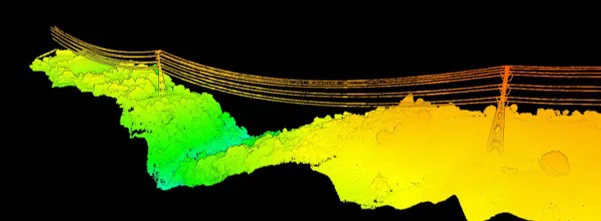
- Structures, foundations, insulator strings and conductors are modelled from LiDAR point clouds and design information.
- The wider corridor is incorporated (terrain, buildings, roads, vegetation) to analyse clearances, access conditions, flood-prone areas and other risks.
- Each element in the model is linked to its technical attributes: asset type, electrical and mechanical characteristics, manufacturer, commissioning date and maintenance history.
The result is a model that does more than look good: it reflects the real geometry of the electricity grid, critical clearances and the logic of how the system is built and operated.etry of the network, critical clearances and the logic of how the system is built and operated.
3.3 Validation, updating and traceability
A digital twin only retains its value if it reflects the current state of the network. For that reason, the process must include:
- Technical validation
Comparing the model against design data, field inspections and additional measurements where needed, ensuring that the twin represents the actual power infrastructure. - Regular updates
Each new inspection campaign (drones, LiDAR, thermography, visual inspection) is not left as a standalone report. The information is integrated into the digital twin of the grid. - Change traceability
The twin preserves the history of modifications, incidents and maintenance actions, making it possible to understand not only how the grid looks today, but also how it has evolved over time.
In this way, the digital twin becomes the single source of truth for engineering, operations and maintenance in electric power systems: a model supported by both traditional inspection and Inspection 4.0, and updated with every relevant decision taken on the network.
4. Operational value: continuity of service and OPEX optimisation
From an operational standpoint, the value of a digital twin for the power grid is best described through the functions it supports.
Key operational functions
- Early identification of risk conditions
Critical crossings, unstable slopes, difficult-to-access areas, vegetation encroachment and other corridor-related risks are easier to identify and quantify. - Prioritisation of interventions by technical criticality
Crews and resources can be allocated to the locations where risk and potential impact are highest, supported by objective information. - Remote validations
Situations that previously required a site visit can often be assessed with sufficient confidence using the model and associated data, reducing unnecessary trips. - Scenario analysis
The impact of extreme weather, floods, fires or localised disruptions on specific segments of the electricity grid can be evaluated before they occur or immediately after an event.
Direct impact on OPEX
- Reduction of unplanned, reactive interventions.
- More efficient use of crews, equipment and access logistics.
- Lower exposure of field teams to hazardous environments.
- Lower likelihood of undetected issues that compromise continuity of service.
In short, better observability of the network leads to more informed operational decisions and more efficient operating expenditure.
5. Value for planning and investment (CAPEX)
In planning, expansion, uprating or modernisation, the digital twin of the electricity grid acts as a technical foundation that reduces uncertainty from the earliest stages.
Key planning applications
- Comparative assessment of routing alternatives
More precise geometric and territorial analysis for new lines or reinforcements, based on a consistent representation of existing infrastructure and terrain. - Early identification of constraints and impacts
Land ownership, existing infrastructure, environmental restrictions, protected areas and regulatory constraints can be identified and evaluated on a common geospatial canvas. - More reliable estimates of volumes and auxiliary works
Supported by accurate geometric models and terrain representation, improving cost estimates and construction planning. - Stronger technical basis for studies, tenders and design reviews
Structured, verifiable and up-to-date information for all stakeholders involved in the project.
Direct impact on CAPEX
- Fewer redesigns caused by incomplete or inaccurate information.
- Lower likelihood of cost overruns during construction.
- More objective comparison of alternatives from the outset.
- More robust technical documentation for approvals and audits.
Thus, a grid digital twin becomes a central tool for planning and investment decisions in electricity transmission and distribution infrastructure.
6. Traceability and compliance
In the power sector, data traceability is both a technical and regulatory requirement. A digital twin does more than organise information: it creates a clear chain of custody that supports each decision.
Key elements of traceability
- Source, date and capture method recorded for each dataset integrated into the twin.
- Full history of model changes, including what was modified, when and why.
- Documented quality-control criteria applied during data integration and validation.
Contribution to technical and regulatory compliance
- Greater ability to demonstrate consistency during audits.
- Verifiable support for operational and planning decisions.
- Reduced risk associated with outdated, unvalidated or poorly documented data.
For operators of electric power systems, this translates into more robust compliance and lower exposure to regulatory and reputational risk.
7. Technical judgement: what makes the difference in a digital twin
The reliability of a digital twin for the power grid depends not only on the technology deployed, but also on the technical judgement applied at every stage of the process.
The value that SIGLA’s team contributes is based on combining state-of-the-art equipment with in-depth experience in:
- Interpreting assets in the field and in models.
- Reading the territory and its constraints.
- Analysing operating conditions with precision and technical coherence.
Technical contributions from the SIGLA team
- Construction of consistent models
Precise integration of geometry, attributes and territorial context, aligned with demanding technical and quality standards. - Methodological review at every stage
Rigorous quality controls to ensure geometric and technical consistency in all phases of the workflow. - Expert interpretation of risks and operational constraints
Technical reading of the corridor and its implications for safety, continuity, maintainability and resilience. - Coordination across engineering, operations and analytics
Alignment of criteria and reduction of discrepancies between internal areas and external stakeholders.
Value delivered to the client
- Critical decisions supported by a single, consistent model instead of multiple partial versions.
- Fewer surprises in the field: risks and constraints identified before execution.
- Greater confidence during audits and external reviews, backed by documented and traceable processes.
In short, the digital twins for the power grid developed by SIGLA combine technology, technical insight and a way of working grounded in rigour, transparency and responsibility towards the territory.
8. Next steps
Organisations considering a digital twin for their power grid, or looking to extend existing capabilities to additional assets or regions, can turn this concept into a concrete roadmap with a short technical working session.
In that session, SIGLA’s team can:
- Review the current status of grid data, inspections and models.
- Identify priority use cases in operations, asset management and planning.
- Outline a pragmatic path to build or strengthen a grid digital twin, aligned with existing constraints and resources.
To arrange this initial technical session, you can contact SIGLA’s team through your usual channels or via the contact form in this website. This first step is often enough to clarify where a digital twin can create the most value in your electricity network.